

Guide


Sleep Aid Ingredients Compared: What the Evidence Supports
For ongoing insomnia, no sleep supplement has strong evidence. Melatonin is the best studied and works best for timing problems such as jet lag; for everyday insomnia, pooled trials found people fell asleep about seven minutes faster. Magnesium, L-theanine and ashwagandha rest on small or low-quality studies, valerian and chamomile have not been shown to work, and sleep specialists suggest against melatonin or valerian for chronic insomnia.
Disclosure: This article links to SuppVista product reviews. Those review pages contain affiliate links, and SuppVista may earn a commission if you buy through them, at no extra cost to you. No company paid for placement in this article. See our editorial policy.
On this page
How the common ingredients compare
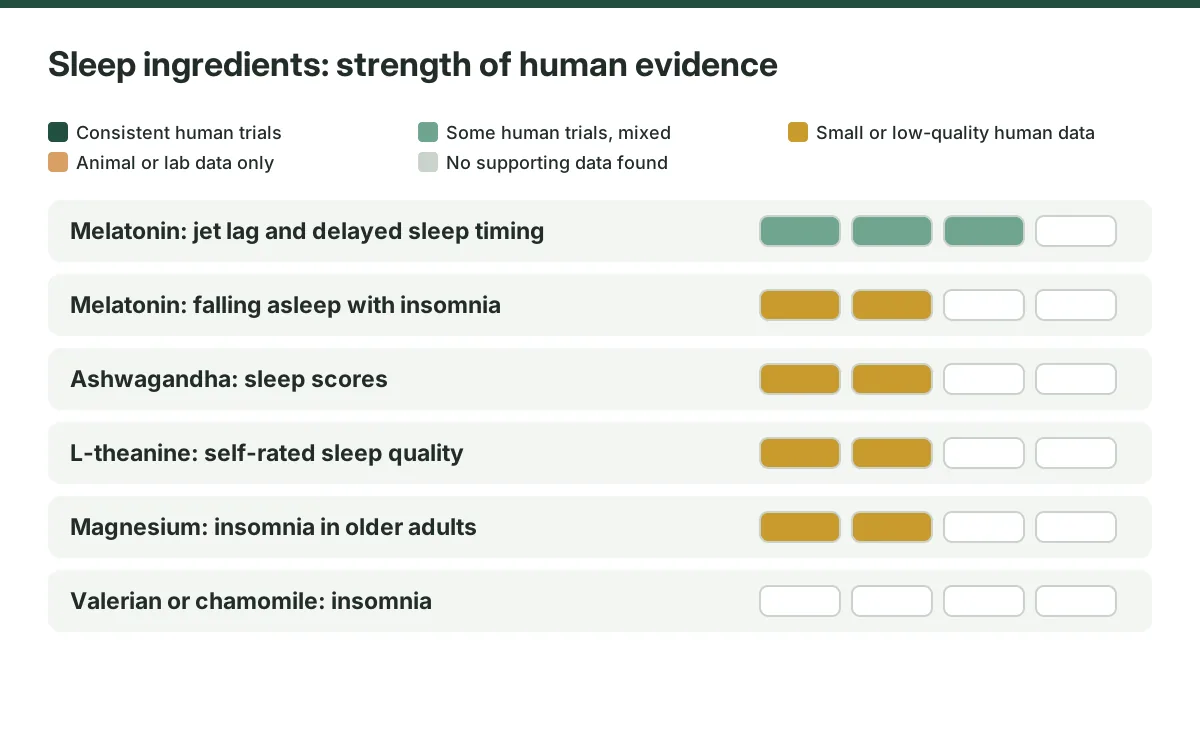
SuppVista summary of the sources cited in this guide. A rating describes the ingredient research for that use, not any product.
| Ingredient | What the research shows | Notes |
|---|---|---|
| Melatonin | Helps jet lag and delayed sleep phase; for insomnia, a meta-analysis of 19 trials found about 7 minutes faster sleep onset and 8 minutes more total sleep | Label accuracy is a problem, especially gummies |
| Magnesium | A review of 3 small trials (151 older adults) suggested faster sleep onset, but the studies were low quality | High intakes cause diarrhea and cramping |
| L-theanine | A 2025 meta-analysis of 18 trials (897 people) found small improvements in self-rated sleep onset and quality | Most trials combined it with other ingredients |
| Ashwagandha | A 2021 meta-analysis of 5 trials (400 adults) found a small improvement, larger at 600 mg/day or more for 8 weeks or more | Long-term safety data are limited |
| Valerian | Not shown effective for insomnia | AASM suggests against it for chronic insomnia |
| Chamomile | Not shown effective for insomnia | Often added in small amounts to sleep blends |
Sources: melatonin, valerian and chamomile (NCCIH clinical digest); magnesium (NCCIH); L-theanine (D'Cunha et al., 2025); ashwagandha (Cheah et al., 2021).
Why melatonin depends on the problem
Melatonin is a hormone the body releases in the evening, and as a supplement it acts more like a timing signal than a sedative. That is why the evidence is strongest for jet lag and for delayed sleep phase, where the body clock is out of step with the clock on the wall. Mayo Clinic's summary describes improved alertness and daytime sleepiness with jet lag, earlier sleep onset with delayed sleep phase, and only a slight reduction in time to fall asleep for insomnia (Mayo Clinic).
The 2017 American Academy of Sleep Medicine guideline weighed that evidence for chronic insomnia and made a weak recommendation against melatonin, as well as against valerian, L-tryptophan and diphenhydramine, the sedating antihistamine in many "PM" pain relievers (AASM guideline at a glance). "Weak" means the panel judged the balance of benefit and harm uncertain, not that these products are dangerous.
Label accuracy: a melatonin-specific problem
In a JAMA study of 25 melatonin gummy brands, only 3 contained an amount within 10% of the label, one contained no melatonin, and one labeled 3 mg contained more than 10 mg (McGill Office for Science and Society). The same article notes that pediatric melatonin overdoses reported to U.S. poison centers rose five-fold between 2012 and 2021. Gummies look like sweets, so storage out of children's reach matters.
Our upcoming melatonin products buying guide covers formats and label checks in detail.
Where reviewed sleep products fit
Elixolve Sleep Oral Strips list 1 mg of melatonin with small amounts of valerian (50 mg), lavender (20 mg), chamomile (10 mg) and hibiscus (10 mg) per strip, according to our review. The melatonin amount is modest; the herbal amounts are small, and as the table shows, valerian and chamomile have not been shown to treat insomnia even at larger doses. The review also notes that inactive ingredients were not disclosed.
Other products touch on sleep from different angles. Stud Performance includes L-theanine inside a 600 mg blend with no individual amount, and Gluconite is marketed around sleep and blood sugar but our review could not find a complete ingredient panel.
Safety points before trying any sleep aid
- Melatonin and medicines. Mayo Clinic lists possible interactions with blood thinners, anticonvulsants, blood pressure and diabetes medicines, sedatives, immunosuppressants and the antidepressant fluvoxamine. Avoid driving for several hours after a dose.
- Older adults with dementia. NCCIH notes guidance that melatonin should not be used in this group because it may worsen mood.
- Kava. Sometimes sold for relaxation and sleep, kava has been linked to severe liver disease.
- Children. Talk to a pediatrician first; bedtime routines are usually tried before melatonin.
- Combining products. Two “sleep” products can double up on melatonin or sedating herbs.
Persistent insomnia, loud snoring, gasping at night or heavy daytime sleepiness deserve a medical assessment. Sleep apnea and other conditions do not respond to sleep supplements.
Choosing what to try, if anything
- Name the problem. Trouble falling asleep at a normal hour, waking at 4 a.m., jet lag and shift work call for different approaches.
- Match the ingredient to the problem. Melatonin fits timing problems; the others have small or uncertain effects.
- Prefer a simple, fully quantified label so you know exactly what you are taking.
- Set a short, defined trial and judge it honestly.
- Keep the non-supplement basics in view. NCCIH notes that relaxation techniques can be helpful parts of a strategy for better sleep habits, and structured talking therapy for insomnia (CBT-I) is covered in our CBT-I comparison.
For the most studied mineral, see our existing guide to magnesium forms and sleep evidence, and for criteria-based shopping see the Sleep Supplement Buying Guide.
Questions readers ask
What is the most effective natural sleep aid?
For jet lag and a late body clock, melatonin has the best support. For general insomnia, none of the common supplements has strong evidence, and guideline panels suggest against melatonin and valerian for chronic insomnia.
Is it safe to take melatonin every night?
Mayo Clinic describes it as generally safe for short-term use and suggests treating it like any sleeping pill, under a doctor's supervision for longer use.
Does magnesium help sleep?
Only small, low-quality studies support it, mainly in older adults with insomnia, and NCCIH says there is not enough rigorous evidence to judge whether it works.