

Guide


Proprietary Blends: What a Total Weight Hides on a Supplement Label
A proprietary blend groups ingredients under one name with a single combined weight. You learn what is inside and their order by weight, but not how much of each you get. That is legal for non-nutrient ingredients in the United States, and it means you cannot check whether a key ingredient matches the amount used in research. The order still tells you more than you might expect, and you can ask the seller for the rest.
Disclosure: This article links to SuppVista product reviews. Those review pages contain affiliate links, and SuppVista may earn a commission if you buy through them, at no extra cost to you. No company paid for placement in this article. See our editorial policy.
On this page
What the rules require
FDA guidance allows a supplement to group ingredients as a "Proprietary Blend", or under a descriptive or invented name, and to state just the total amount of the blend. If the individual amounts are left out, the ingredients must be listed from the largest to the smallest by weight (FDA compliance guide).
Nutrients such as vitamins and minerals usually appear above the blend with their own amounts. The blend tends to hold the herbs, amino acids and branded extracts, which are often the ingredients the marketing is built around.

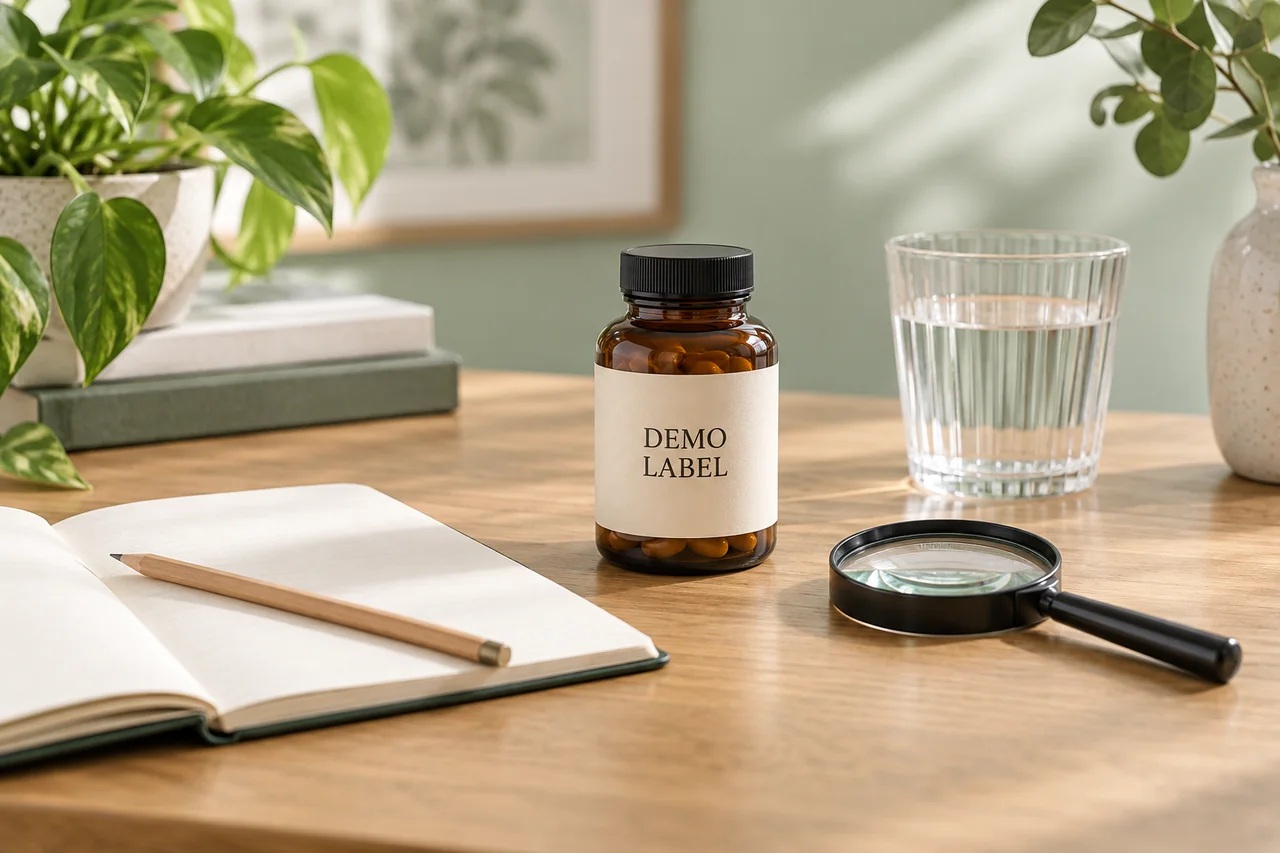
Fictional label for illustration. Only the nutrients above the blend have individual amounts.
Why researchers and regulators find blends frustrating
Scientists from the NIH Office of Dietary Supplements and the FDA have written that blends make it hard for consumers to judge whether a product can deliver its intended benefit, complicate efforts to measure what people actually take, and raise safety concerns because the amounts are not visible (Nutritional Outlook report on the 2023 Journal of Nutrition paper). The FDA can see exact amounts in a manufacturer's records, but buyers cannot.
Companies usually defend blends as a way to protect a formula from copycats. That may be true, but the trade-off falls on the reader: you are asked to trust a dose you cannot see.
What the order still tells you
Because the ingredients must appear in descending order by weight, you can set limits without knowing exact amounts:
- The first ingredient is at least the total divided by the number of ingredients. In a 600 mg blend of three ingredients, the first must be at least 200 mg.
- Any ingredient is at most the total divided by its position. The second can be no more than 300 mg (600 ÷ 2), the third no more than 200 mg (600 ÷ 3).
- Later ingredients can be tiny. Nothing stops the last ingredient from being a few milligrams.
These are boundaries, not estimates. They are most useful for spotting when a headline ingredient simply cannot be present at a research-level amount. If a study used 300 mg of an herb and that herb sits fourth in a 400 mg blend, it can contribute at most 100 mg.
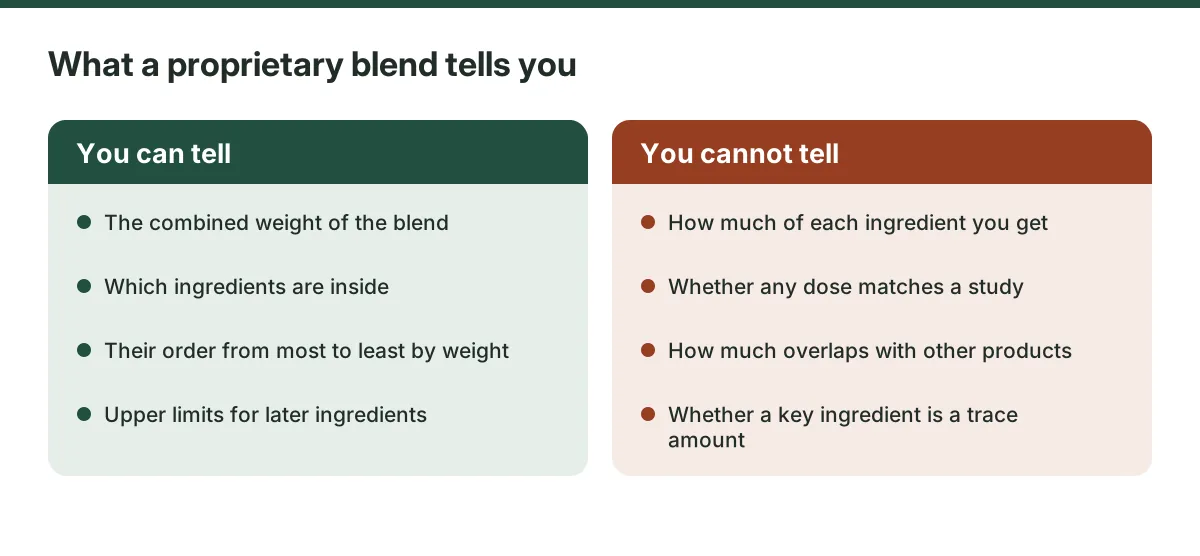
The order of ingredients gives upper and lower limits, not amounts.
Real examples from SuppVista reviews
| Product (review) | Blend as recorded in our review | What the arithmetic shows |
|---|---|---|
| Alpha Drive 24 | 800 mg per 2 capsules covering seven entries (epimedium, tongkat ali, saw palmetto, wild yam, sarsaparilla, nettle root, boron chelate) | With seven ingredients, the last can be at most about 114 mg, and could be much less |
| Stud Performance | 600 mg blend of L-theanine, rhodiola extract and taurine, alongside quantified folate, vitamin B12 and magnesium | L-theanine, listed first, is at least 200 mg; taurine, listed last, is at most 200 mg |
| Pineal Guardian | 1,202 mg per 2 mL covering 11 plant and mineral entries | The eleventh entry can be at most about 109 mg; the review notes elemental boron is undisclosed |
| LightSteps Pro | 500 mg per capsule covering six entries, including beet root, L-citrulline and hibiscus | The sixth can be at most about 83 mg per capsule |
Some products go further and give no amounts at all. The AdaptoGen review found nine herbs named on the sales page with no amount for any of them and no blend total, which leaves even less to work with than a blend.
Questions to ask before buying
- What is the amount of each ingredient in the blend? Some vendors will answer by email; a refusal is useful information too.
- Which ingredient is the product’s main selling point, and where does it sit in the order? If it is near the end of a long list, its amount may be small.
- Is the extract standardized? A blend can hide both the amount and the strength of an extract.
- Does anything in the blend overlap with other products you take? Caffeine sources, stimulants and sedating herbs are common examples where totals matter.
- Are there safety-relevant ingredients you cannot quantify? Hormone precursors, stimulants or herbs with medicine interactions deserve exact amounts before you take them.
If you are comparing two products, a fully disclosed label is easier to evaluate even when it looks less impressive. Our label basics are in How to Read a Supplement Facts Label, and our sales video checklist explains where to find the full panel on a video-led offer.
Questions readers ask
Is a proprietary blend a sign of a bad product?
Not necessarily. It is a sign that you cannot check the doses. Whether that matters depends on how much of the product's claim rests on the hidden ingredients.
Can I assume the ingredients are split equally?
No. The rules only require descending order. An equal split is one possibility among many, and the later ingredients may be present in much smaller amounts.
Why do some labels show amounts for vitamins but not herbs?
Vitamins and minerals are listed with their own amounts and Daily Values, while non-nutrient ingredients can be grouped into a blend with a single total weight.