

Ingredient


Berberine: Blood Sugar Evidence, Side Effects and Drug Interactions
Berberine is a yellow plant compound with more human research behind it than most blood sugar supplements. The trials point to a modest lowering of blood glucose and cholesterol in people with type 2 diabetes, mostly from small, short trials of uneven quality. Berberine commonly upsets the stomach, it should not be used in pregnancy, while breastfeeding or in infants, and it slows the breakdown of several medicines, so it is not a casual add-on for anyone on prescription drugs.

On this page
Disclosure: This article links to SuppVista product reviews. Those review pages contain affiliate links, and SuppVista may earn a commission if you buy through them, at no extra cost to you. No company paid for placement in this article. See our editorial policy.
What berberine is
Berberine is found in several plants used in traditional Chinese and Ayurvedic medicine, including European barberry, goldenseal, goldthread, Oregon grape, phellodendron and tree turmeric (NCCIH). Supplements usually contain a purified form, most often berberine hydrochloride (HCl), rather than the whole herb. Labels sometimes name the plant source; one product SuppVista reviewed, Insulin Herb, identifies phellodendron bark.
That distinction matters because most trials used purified berberine at measured doses. A capsule of powdered barberry root contains an unknown and probably much smaller amount.
What the trials found
The largest recent analysis pooled 50 randomized trials with 4,150 people who had type 2 diabetes (Wang et al., 2024). Most participants took 0.9 to 1.5 grams of berberine a day for about three months. Compared with control groups, which were often other diabetes drugs:
- Blood glucose two hours after a meal fell by about 1.6 mmol/L (roughly 28 mg/dL).
- Fasting glucose fell by about 0.6 mmol/L, a result the authors called borderline.
- HbA1c, the three-month average, did not change significantly overall, but fell by about 0.7 percentage points in trials that compared berberine with placebo.
- LDL cholesterol and triglycerides both fell by about 0.3 mmol/L.
When berberine was added to standard glucose-lowering drugs, the combined groups did better on glucose and HbA1c than drugs alone. That is useful information for doctors, and it is also why berberine and diabetes medicine together need supervision.
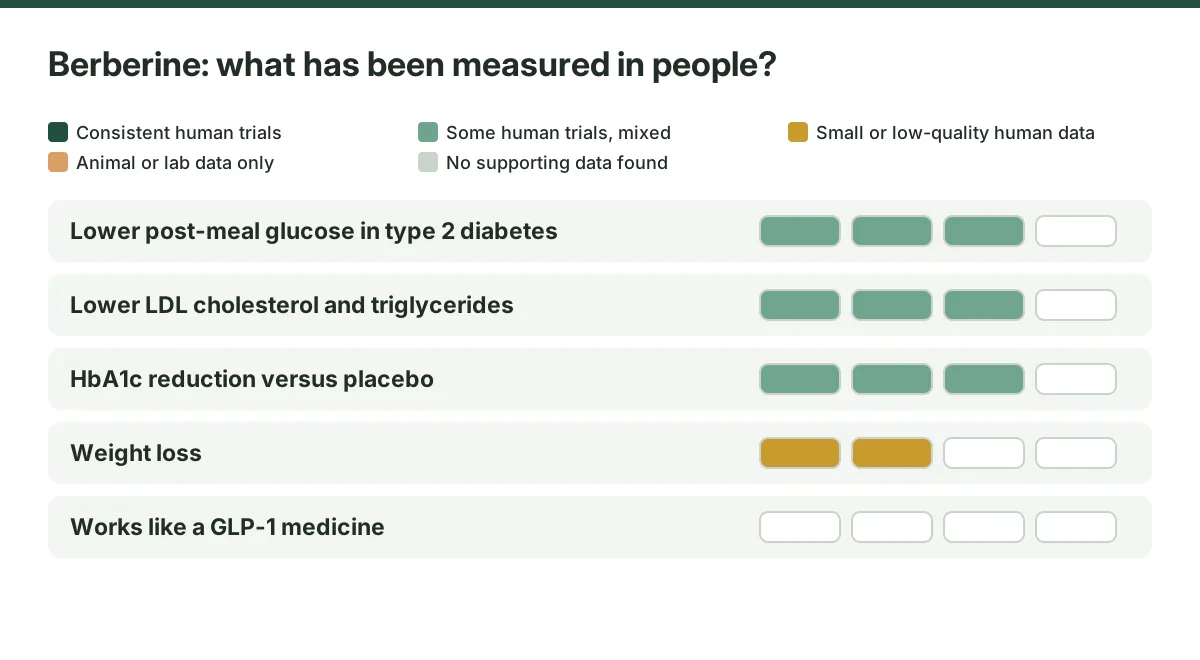
SuppVista summary of the sources cited below. 'Some human trials, mixed' means many small trials of uneven quality.
The weaknesses are significant. Almost every trial was conducted in China, 31 of the 50 were rated low quality, many did not describe how participants were randomized or blinded, and results swung when single studies were removed. An umbrella review of 11 earlier meta-analyses reached a similar position: berberine affects glucose, insulin resistance and blood lipids, but high-quality trials are still needed (Li et al., 2023). NCCIH describes the glucose effect as modest (NCCIH).
What about weight loss?
Berberine is often marketed online as a natural alternative to GLP-1 weight-loss medicines. NCCIH notes that a few preliminary studies suggest a role in weight loss but that there is not enough rigorous evidence to say whether it works. None of the research summarized here compared berberine with semaglutide or tirzepatide, and the weight evidence is thin. Calling it "nature's Ozempic" is marketing, not a research finding.
Forms and doses on labels

Form names matter when you compare a label with research.
Most trials used berberine HCl. Newer products use dihydroberberine, a related form sold as better absorbed. In a pilot study of five men, 100 mg of dihydroberberine produced higher blood levels of berberine than 500 mg of berberine HCl, but blood glucose and insulin after a test meal were no different between groups (Moon et al., 2021). That supports the absorption claim in a very small group; it does not show better results.
Here is how berberine appears on some labels SuppVista has reviewed:
| Product | Berberine on the label | What to keep in mind |
|---|---|---|
| Insulin Herb (Berberine) | Berberine HCl 500 mg per capsule, with milk thistle and piperine | Check the directions to see how many capsules a day the label intends |
| SLIN Glucose Disposal | Berberine HCl 500 mg per 4-capsule serving, with bitter melon, cinnamon and alpha-lipoic acid | Marketed to people who train; the review notes it is not for people using glucose-lowering drugs |
| GLP-1 Plus | Dihydroberberine 200 mg per 2 capsules, with chromium, gymnema and cinnamon | The label's "1,000 mg berberine equivalent" is a marketing comparison, not a trial result |
| WeGoSlim | Berberine HCl named as the lead ingredient; no amount found | Without an amount, the formula cannot be compared with research |
For a wider comparison of glucose ingredients and products, see our blood sugar supplements buying guide.
Side effects
Digestive effects are the most commonly reported: abdominal pain, constipation, diarrhea, nausea and vomiting, according to NCCIH. Studies have often divided the daily amount, for example 300 mg three times a day in the interaction study described below, so it is worth checking how a label spreads its servings across the day.
Who should not take berberine
NCCIH advises against berberine for:
- Pregnant or breastfeeding people. Berberine has been linked to a dangerous build-up of bilirubin.
- Infants. It can cause or worsen newborn jaundice, which could lead to kernicterus, a life-threatening condition.
People with diabetes who use insulin or other glucose-lowering drugs should only use it with their prescriber's knowledge, because the effects can add together.
Drug interactions
In a study of healthy men, berberine 300 mg three times a day for two weeks slowed three liver enzymes that break down many common medicines (Guo et al., 2012):
- CYP2D6 activity dropped sharply; the marker ratio for the test drug dextromethorphan rose about ninefold.
- CYP2C9 activity fell; the marker ratio for losartan roughly doubled.
- CYP3A4 activity fell; exposure to midazolam rose by about 40%.
Many prescription drugs depend on these enzymes, so slower breakdown can mean higher drug levels than intended. A pharmacist can check your specific medicines. Bring the actual label, because combination products may add other ingredients with their own interactions, such as piperine or St. John's wort.
Questions readers ask
How long does berberine take to work?
Most trials lasted about three months, and some ran for only a few weeks. They measured changes in blood tests, not how people felt, so the only way to know whether anything has changed is through the same tests, ideally with your clinician.
Is it safe to take berberine with metformin?
Many trials gave berberine alongside standard drugs, and glucose fell further than with drugs alone. That is exactly why the combination needs medical supervision rather than self-management.
Does berberine lower cholesterol?
The pooled trials showed modest drops in LDL cholesterol and triglycerides in people with type 2 diabetes. It has not been shown to replace prescribed cholesterol treatment, and berberine's enzyme effects matter for people taking cholesterol drugs too.
Suggested products
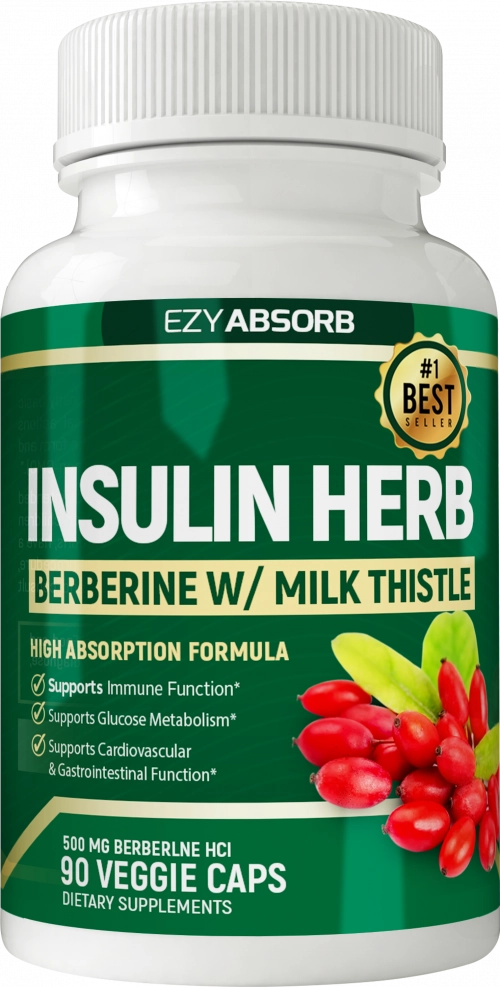
Insulin Herb (Berberine)
The review examines a berberine HCl capsule formula combined with milk thistle extract and piperine.

SLIN Glucose Disposal
A review of Enhanced Labs’ multi-ingredient capsules, including berberine, bitter melon, cinnamon and alpha-lipoic acid.

Vertigenics
The review identifies chromium picolinate and zinc gluconate alongside berberine, alpha-lipoic acid, green tea and resveratrol.
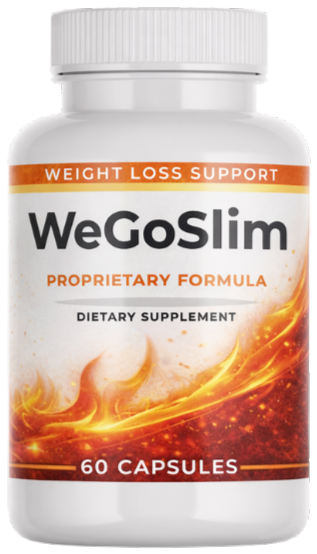
WeGoSlim
A review of a berberine-led capsule formula with olive leaf, moringa, holy basil and other botanicals.